


If you are looking to plan a remote team retreat in Thailand, you’ve likely reached a breaking point.
It’s Tuesday morning. You’ve just finished your third back-to-back Zoom call of the day. You look at the little grid of faces on your screen. Half of them are looking off-camera (probably at another Slack thread), and the other half have their cameras off entirely, replaced by a static profile picture from three years ago.
You’re the Workplace Manager. You’re supposed to be the “culture guardian.” But honestly? You’re tired too.

The dirty secret of the remote work era is that while we’re technically “connected” 24/7, our teams have never felt more isolated. We’ve traded the water cooler for a “Random” Slack channel that’s mostly just GIFs of crying cats. This isn’t just a vibe shift; it’s a productivity killer. When people don’t know each other, they don’t trust each other. When they don’t trust each other, they don’t take risks, they don’t give honest feedback, and they definitely don’t stick around when a recruiter dangles a 10% raise in front of them.
At Offsite Thailand, we see this daily in our inquiry forms. People aren’t just looking for a “holiday.” They are looking for a way to stop the rot of disconnection. They want to move from “Zoom Fatigue”—that soul-crushing lethargy of digital-only life—into “Team Flow.”
But how do you actually do that in four days? And why Thailand? Let’s get into the weeds.
The “Disconnection Tax”: Why Your Remote Culture is Costing You Money
Let’s talk about the CFO for a second. Whenever a People Manager suggests a company retreat in Thailand, the first question is usually about the budget. “Why are we flying 50 people to Southeast Asia when we could just do a virtual escape room?”
Here’s why: The virtual escape room is a waste of time.
The “Disconnection Tax” is the hidden cost of a fragmented team. Think about the last time a project was delayed because two departments misunderstood a Slack message. Think about the “brain drain” when a senior engineer quits because they feel like a nameless cog. According to Buffer’s 2026 report on remote work, loneliness remains the top struggle.
When you lose a key team member, it costs roughly 1.5x to 2x their annual salary to replace them. If a retreat keeps just two people from quitting, it’s already paid for itself. That’s the math you need to lead with. We’ve put together a full breakdown of company retreat costs in Thailand to help you build that case, but the real value is in the stuff you can’t put on a spreadsheet: the trust.
Why a Remote Team Retreat Thailand is the Reset Button You Need
You could host a retreat in a gray hotel in the suburbs of London or New York. But your team’s brains wouldn’t leave “work mode.” They’d still be thinking about the commute, the weather, and the grocery list.
Thailand is a “pattern interrupt.” The moment your team steps off the plane in Bangkok or Chiang Mai, their senses are flooded. The heat, the smell of street-side lemongrass, the organized chaos of the traffic—it forces the brain to pay attention to the present moment.
This sensory overload is a feature, not a bug. It breaks the “autopilot” of home-office life. It’s a lot harder to be a “corporate avatar” when you’re navigating a night market together or trying to figure out if that curry is “Thai spicy” or “Farang spicy.”
We’ve found that Chiang Mai is often the perfect offsite destination for remote teams because it combines high-speed internet (essential for those “workation” hours) with a mountain-town soul that feels a world away from a laptop screen.
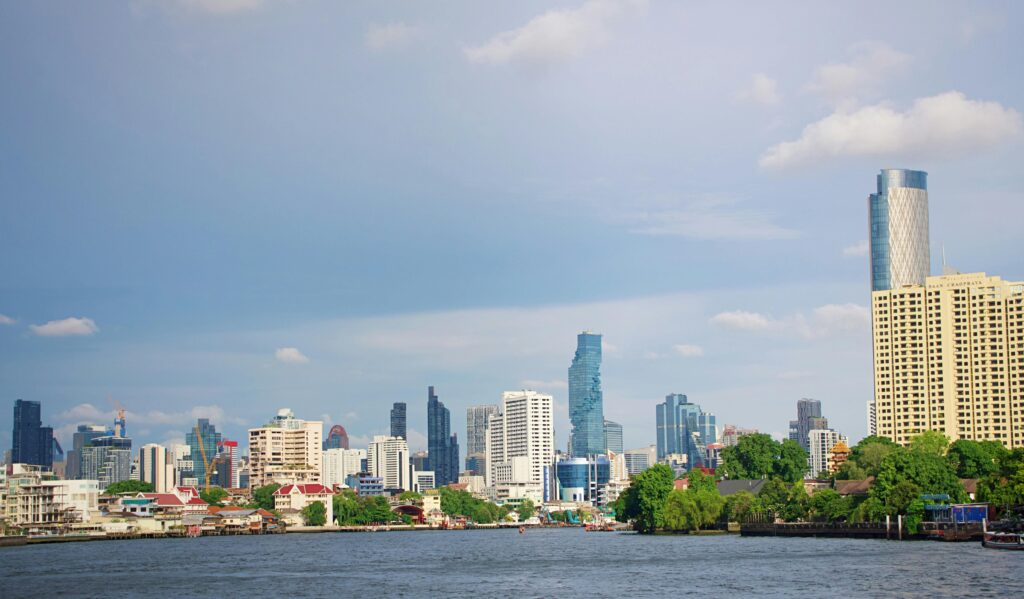
The 4-Day “Flow” Itinerary: A Narrative Approach
Forget those rigid corporate schedules where every 15 minutes is accounted for. That’s just Zoom life in a different timezone. To build culture, you need a mix of structure and serendipity.
Day 1: Decompress and Land
The first day is about one thing: lowering the collective heart rate. Most of your team has been traveling for 12+ hours. Don’t put them in a conference room.
We like to start our retreats at a place like Phuket or Koh Samui. Why? Because you can get from the airport to a beachfront villa in 30 minutes.
The “Arrival Ritual” should be simple. A cold drink, a change of clothes, and a sunset dinner where the only rule is: No Slack talk. This is where the “humanizing” happens. You find out that your quietest accountant is actually a world-class scuba diver. You learn about the person, not just the title.
Day 2: The Alignment (The “Deep Work” Morning)
By Tuesday, the jet lag is fading and the “vacation” novelty has settled. This is when you do the heavy lifting.
We recommend a 4-hour high-intensity strategy block in the morning. Use a “non-office” space. In Bangkok, we use creative studios that look out over the river. In the north, we might use an open-air teak pavilion.
The goal here isn’t to clear your inbox. It’s to tackle the “big questions” that get lost in the day-to-day. Where are we going? Why do we care? For founders, this is the time for a leadership retreat reset.
Day 3: The Adventure (The “Bonding” Breakthrough)
Wednesday is the day everyone remembers. This is where you do something slightly uncomfortable together.
In Thailand, the options are endless, but we try to avoid the “canned” tourist stuff. Think:
- A private boat charter through the limestone karsts of Krabi.
- A “Chef’s Table” cooking challenge in an organic garden in Chiang Mai.
- A community-led project in a local village near Kanchanaburi.
Shared novelty creates shared memories. These memories become the “cultural glue” that holds the team together when they’re back to being pixels on a screen. If you need more ideas, we’ve vetted 25 team-building activities in Thailand that actually work (and don’t involve trust falls).
Day 4: Integration and Departure
The last day is the most overlooked. Most teams just pack up and leave.
Instead, use the morning for a “Retro.” What did we learn? What are we taking back to our digital world? It’s about making the transition from “Thailand Mode” to “Work Mode” without losing the connection. Then, a final big lunch before people head to the airport.
The “Workplace Manager” Playbook: Avoiding the Common Pitfalls
If you’re the one planning this, you’re probably worried about a thousand things. “Will the Wi-Fi work?” “What if someone hates spicy food?” “Is Pattaya too wild for a corporate group?” (Quick answer: usually yes, unless you know exactly where to go).
Here are the three biggest mistakes we see people managers make:
1. The “Over-Scheduled” Nightmare
You’ve spent a lot of money to get people here, so you feel like you need to fill every minute. Don’t. Remote workers value their freedom. If you don’t give them “white space” to just sit by the pool or walk around the local neighborhood, they will end up resentful and exhausted.
2. Ignoring “Me Time”
Introverts exist. For some people, 72 hours of constant social interaction is draining. Ensure there is a quiet space for people to recharge. Thailand’s hospitality is built for this—most resorts have quiet corners and spas that are perfect for a 2-hour “social detox.”
3. Being the “Travel Agent” Instead of the “Manager”
If you spend the whole retreat worrying about bus schedules and dietary requirements, you aren’t actually with your team. This is the main reason we exist. You should be participating in the activities, not standing at the back with a clipboard. You can read our “Retreat Stories” to see how other managers have successfully stepped back from the logistics to focus on the people.

Why Thailand is Asia’s best Remote Retreat Destination for 2026
When you look at the best corporate retreats in Asia, you see the same names: Bali, Singapore, Tokyo, Thailand.
But Thailand is the “Goldilocks” zone. Singapore is efficient but incredibly expensive and “sterile.” Bali is beautiful but the traffic can turn a 20-minute transfer into a 3-hour ordeal.
Thailand offers the perfect balance of world-class infrastructure (BKK is one of the best airports in the world) and that raw, “uncensored” adventure that teams crave. Plus, your budget goes significantly further here. You can afford a 5-star experience in Khao Lak or Koh Lanta for the price of a 3-star hotel in London.
For teams coming from hubs like Singapore or Hong Kong, Chiang Mai is an easy win—a short flight, amazing food, and a cool mountain climate that’s a welcome break from the city humidity.
The CFO Conversation: Closing the Deal
So, how do you actually get this signed off? You stop talking about “culture” and start talking about “continuity.”
Remote teams are fragile. Without physical touchpoints, people become mercenaries, they work for the highest bidder. A retreat is an investment in loyalty.
When you sit down with your leadership, bring the data. Bring the turnover costs. But also bring the vision. Explain that a 4-day pattern interrupt in a place like Hua Hin or Koh Tao is the most efficient way to “refill the tank” of your team’s morale.
And if they’re still on the fence? Tell them to read our guide on how to plan a stress-free company retreat. It shows that this isn’t just a holiday—it’s a structured, managed, and high-ROI business event.
Final Thoughts: The Monday After
I often ask our partners to think about the Monday morning after the retreat.
Instead of the usual “how was your weekend” pleasantries on Zoom, the Slack channel is buzzing. Someone’s sharing a photo of the team trying to navigate a long-tail boat in Krabi. Someone else is making a joke about the “spicy noodle incident” in Bangkok. Fantastic memories, built to align a team and make your people happy.
The pixels have become people. The “Zoom Fatigue” has been replaced by a genuine sense of “Team Flow.”
That’s the power of a well-planned offsite. It doesn’t just “fix” your culture for four days; it builds a foundation that lasts for six months.
If you’re ready to stop being the “Zoom Guardian” and start being the architect of a culture people actually want to belong to, we’re here to help. At Offsite Thailand, we don’t do templates. we do hospitality. We find the right locations, we handle the logistics, and we make sure you get to actually enjoy the sunset dinner with your team.

Take the first step. It’s probably the easiest thing you’ll do all week.
Get a Free Estimation for your Thailand Retreat