


Beyond the Resort: 25 Intentional Company Retreat Activities in Thailand
If you’re hunting for company retreat activities in Thailand, you’ve likely already sold the leadership team on the destination. You know Thailand is world-class, and you know your team is overdue for some face-to-face time.
Now comes the part where most company retreats either find their rhythm or quietly fall apart: What do you actually do once you land?
A retreat rarely fails because the hotel wasn’t fancy enough. It fails because the activities were just a “filler.” When done right, the right itinerary can reset your strategic direction, patch up cross-team friction, and build the kind of trust that remote Slack channels just can’t replicate. When done wrong? You’re left with awkward small talk and “forced fun.”
The Offsite Thailand team has run, tested, and tweaked these 25 activities over the years. We’ve grouped them by the business results they actually drive, so you can build a schedule that creates momentum, not just a nice corporate Instagram feed.
Before you’re wondering what team building offers a remote retreat, check out this article about how remote team building boosts team happiness and efficiency
Picking Your Base
If you’re still weighing your options, here’s a good place to start:
Company Retreat Activities in Thailand
For teams in the APAC region (and increasingly the US and Europe), Thailand is a logistical powerhouse. You’re getting:
- Easy Access: Bangkok is one of the world’s best-connected hubs.
- Unmatched Value: High-end hospitality that doesn’t drain the annual budget.
- Infrastructure: Fast Wi-Fi and reliable transport, even in the mountains.
The real magic, though, is the flexibility. You can spend the morning in a high-stakes strategic workshop and the afternoon on a jungle trek. That blend is why it’s the top choice for startups and remote-first giants.
High-Leverage Activities: 25 Ways to Move the Needle

1. The Strategy & Alignment Block
These aren’t “meetings.” They are high-leverage sessions designed to get everyone rowing in the same direction.
- 12-Month Vision Reset: We recommend starting with a CEO-led direction, then moving into breakout groups to stress-test those assumptions. Chiang Mai’s quiet mountain air is perfect for this level of focus.
- Future Headlines: Ask your team: What does the front page of TechCrunch say about us in 2027? It’s a fast way to surface hidden ambitions.
- Departmental Pressure Test: No fluff. What’s slowing us down? What needs to be cut immediately?
- Founder AMA: A completely unfiltered Q&A. This is where you build real psychological safety.
- Walking Strategy Sessions: Don’t stay in the boardroom. Movement improves creative output and lowers defensive barriers.
2. Building Real Trust
Remote teams often lack emotional “depth.” These activities bridge the gap between icons on a screen and real people.
- Failure Night: One for the brave. When leaders share their biggest professional “oops” moments, it humanizes the hierarchy and makes it safe for others to take risks.
- Guided Trust Dinners: Use facilitated prompts to move past “What do you do for the company?” to “What actually drives you?”
- Blindfold Communication: A classic for a reason. It highlights exactly where your verbal instructions are failing under pressure.
- The Appreciation Circle: It sounds simple, but public acknowledgment is the most overlooked tool in the retention toolbox.
- Strength Mapping: Aligning what someone is actually good at with the company’s current needs.
3. Cultural Immersion
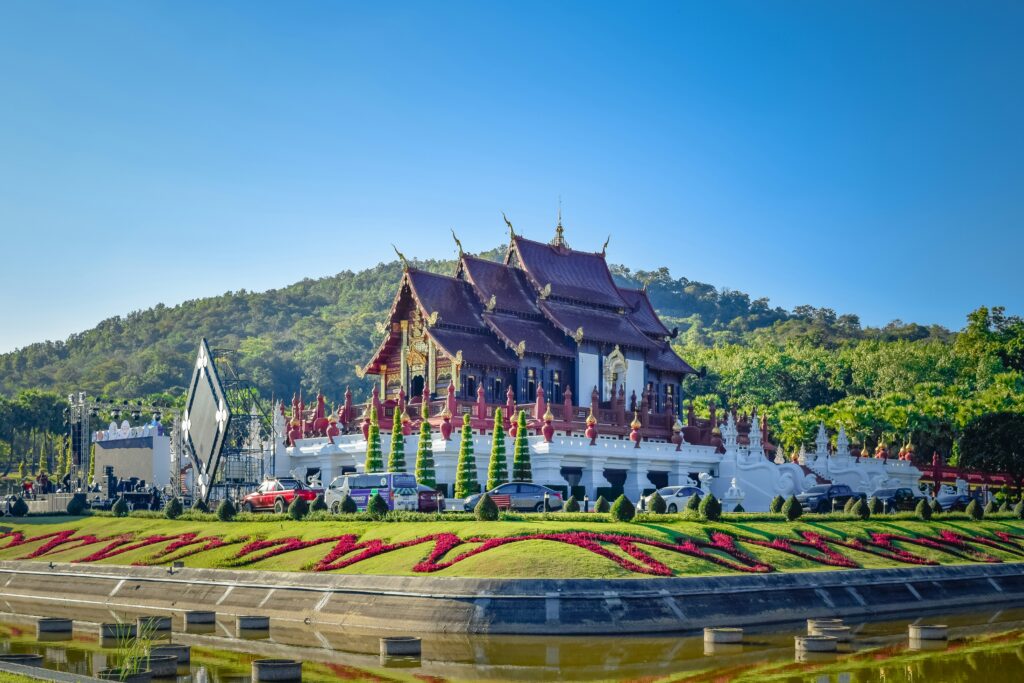
Thailand is famous for its culture; use it to create shared memories.
- The Cooking Challenge: Forget a standard class, make it a competition judged on teamwork and presentation. For any team looking for company retreat activities in Thailand, this is a must consider team-building challenge.
- Muay Thai Class: It’s high energy and beginner-friendly. We’ve found that “shared discomfort” (learning a new physical skill) accelerates bonding faster than any happy hour.
- Temples & Reflection: A morning at Wat Phra Singh followed by a gratitude session. It grounds the team in the local environment.
- Street Food Scavenger Hunt: Send teams into the Chiang Mai Sunday Market or Siam One with a budget and a list of rare dishes to find.
- Lantern Release (Lanna Style): A symbolic way to “release” old frictions and start the next quarter fresh.
4. Energy & Adventure
Reset the mental fatigue that comes with high-growth scaling.
- Zipline Challenges: For the adrenaline junkies; nothing builds fast trust like hurtling through the canopy together.
- Island Hopping (Phuket): The ultimate reward for a hard-working team.
- Jungle Trekking: Use designated trail stops to discuss business prompts. Fresh air = fresh ideas.
- Kayak Coordination: Synchronization is everything in a startup. You’ll see it play out in real-time on the water.
- Fitness Bootcamp: Great for high-performance cultures that love a little morning competition.

5. Innovation & Collaboration

Unlocking the creative “flow state.”
- The 24-Hour Hackathon: Not for the faint of heart, but incredible for solving internal bottlenecks overnight. Company retreat activities in Thailand don’t always need to be focused on relaxation, they can also be productive.
- The Company Documentary: Have teams film interviews and “behind the scenes” moments. It’s a hilarious, lasting cultural asset.
- CSR Projects: Giving back to a local Thai school or environmental project provides a shared sense of purpose.
- Crisis Simulation: Throw a fictional emergency at mixed departments and watch how they solve it under pressure.
- The Commitment Ceremony: Before heading to the airport, every member writes down one personal shift they’re making. It prevents “retreat amnesia.”
How far in advance should we plan company retreat activities in Thailand?
For groups under 15 people, 6–8 weeks is usually sufficient.
For larger groups (20+), peak season dates, or fully customized itineraries, 3–5 months is recommended.
Thailand’s high season (November–March) sees increased demand for premium venues, facilitators, and activity providers — especially in destinations like Chiang Mai and Phuket. Booking early ensures better pricing, availability, and scheduling flexibility.
What is the ideal group size for team-building activities in Thailand?
Most activities work best with 10–40 participants.
Smaller executive teams benefit from deeper strategic workshops and facilitated discussions. Larger groups often perform better with structured rotations, mixing strategy sessions, cultural immersion, and physical activities to maintain energy levels.
For groups above 50, professional coordination becomes essential to avoid bottlenecks in transport, catering, and activity flow.
Are company retreat activities in Thailand suitable for international teams?
Yes, Thailand is particularly well-suited for global companies.
English is widely spoken in hospitality and professional event services. International airports in Bangkok and Phuket make access easy from Asia-Pacific, Europe, and the Middle East.
For distributed teams who have never met in person, Thailand offers a neutral and exciting location that feels equally “new” for most participants — which levels the playing field culturally.
What types of companies benefit most from a retreat in Thailand?
Thailand works especially well for:
– Remote-first startups
– Funded tech companies scaling rapidly
– Agencies with distributed teams
– Executive leadership groups
– Hybrid companies seeking culture reset
Because the cost-to-quality ratio is strong, companies can invest in higher-quality experiences without exceeding budget — which improves overall retreat ROI.
How do you balance productivity with relaxation during a retreat?
The key is sequencing.
High-performing retreat agendas alternate between:
1. Deep cognitive work (strategy workshops)
2. Physical or experiential sessions (adventure, culture)
3. Informal connection time (shared meals, reflection circles)
Stacking too many workshops back-to-back reduces engagement. Likewise, scheduling only leisure activities misses the opportunity for alignment.
Thailand’s diversity makes it easier to strike this balance within a 2–4 day structure.
What are the most overlooked retreat activity mistakes?
Companies often:
1. Overpack the schedule with back-to-back sessions
2. Skip structured facilitation for sensitive discussions
3. Choose activities based solely on “fun” value
4. Underestimate transportation timing between venues
5. Ignore dietary and cultural considerations
Well-designed retreat activities should support a larger business objective — not just fill time.
Can retreat activities be customized around company goals?
Yes (and they should be.)
For example:
If your objective is improving cross-functional collaboration, activities should mix departments intentionally.
If your goal is leadership clarity, the focus should shift toward facilitated workshops and reflection sessions.
If morale is low, experiential and high-energy activities can reset emotional tone before strategic sessions begin.
Customization dramatically increases retreat impact compared to pre-built hotel packages.
Is Thailand appropriate for executive-level retreats?
Absolutely.
Luxury venues in Chiang Mai and Phuket provide privacy, comfort, and professional meeting environments suitable for leadership planning. Thailand allows executive teams to step outside their daily operating context while maintaining access to high-quality accommodation, dining, and facilitation resources.
Executive retreats often blend strategic planning with wellness elements such as mindfulness sessions or curated cultural experiences — creating a balanced environment for high-level thinking.
What role does professional planning play in retreat activity success?
Professional coordination which Offsite Thailand provides, ensures:
1. Activity flow matches team energy
2. Vendors are vetted and reliable
3. Transport logistics are smooth
3. Contingencies are built in
4. Business objectives are reflected in the agenda
Without this layer, internal organizers often become overwhelmed managing operational details, which reduces the retreat’s strategic impact.
How do retreat activities improve long-term team performance?
When structured correctly, retreat activities:
1. Improve psychological safety
2. Clarify strategic direction
3. Reduce interdepartmental friction
4. Increase retention through shared memory
5. Strengthen leadership trust
The outcome isn’t just a great trip, it’s sustained alignment and improved execution after returning to work.
How to Actually Plan This Without Losing Your Mind
We get asked all the time: “Can we just book a hotel package?” Sure, you can. But a hotel package usually gives you a generic buffet and a meeting room. They don’t understand your energy flow or your business objectives. The logistics are 70% of the battle. A professional partner ensures your transit is seamless and your “cognitive” sessions aren’t scheduled right after a heavy 3-course Thai lunch (the ultimate productivity killer).

How can Offsite Thailand Help?
Don’t just pick activities at random. Ask yourself: Are we repairing a fractured culture, or are we fueling a growth phase? If you’re ready to design an offsite that actually moves the needle, let’s chat: